


About the Author
Dale Folland is a qualified nutritionist, a USANA Brand Ambassador of 22 years, and the founder of Freeze Tub, a recovery ice bath company. Having lived in Canada for a decade and now based in New Zealand, Dale has spent over two decades educating people across three countries on the science of supplementation and cellular nutrition. He operates Perfect Health Supplements as an authorised USANA retailer serving customers in New Zealand, Australia, and the USA.
USANA BiOmega Omega-3. The Research, the Risks, and What Makes It World Class.
Omega-3 is one of the most researched supplements in the world. A qualified nutritionist and 22-year USANA Brand Ambassador cuts through the noise and explains what the science actually says, why most fish oil products fall short, and what sets USANA BiOmega apart.
If you’re only going to take one supplement beyond a good daily multivitamin, most health professionals would tell you to make it Omega-3 Biomega. The research behind it spans decades, covers cardiovascular health, brain function, joint inflammation, eye, and skin health and the all-important mental wellbeing. It’s also some of the most consistent evidence in the entire supplement space.
But here’s the problem. The omega-3 market is flooded with cheap, poorly made products that deliver far less than they promise. Some of them are rancid before they even reach you. Others contain doses too low to have any measurable effect, and some are inaccurate with their quantities.
After 22 years in this industry, I’ve seen people write off omega-3 entirely because a cheap product did nothing for them, when the real issue was the product, not the nutrient.
This chapter covers what omega-3 actually does, why quality matters more here than almost anywhere else in supplementation, and why USANA BiOmega omega-3 is the product I’ve recommended consistently throughout my career.
What Omega-3 Actually Is
Omega-3 fatty acids are a family of polyunsaturated fats that your body cannot produce on its own – we like this already, right? So if it’s a nutrient that is not produced by the body, it must come from food or supplementation. The three main types are ALA, EPA, and DHA, and they are not interchangeable.
ALA comes from plant sources like flaxseed and chia seeds. Your body can convert ALA to EPA and DHA, but the conversion rate is poor, typically less than 5% for EPA and even lower for DHA.1 This is why plant-based omega-3 sources are not an adequate substitute for marine-derived EPA and DHA, and why vegetarians and vegans are at particular risk of omega-3 deficiency despite eating foods marketed as omega-3 rich.
EPA (eicosapentaenoic acid) is the form most strongly associated with reducing systemic inflammation, supporting cardiovascular health, and mood regulation. Research has linked EPA supplementation to reductions in triglycerides, improvements in arterial function, and support for people managing depression and anxiety.2
DHA (docosahexaenoic acid) is the structural fat of the brain and retina. Around 60% of the dry weight of the brain is fat, and DHA makes up a large proportion of that. It’s critical for cognitive function, visual acuity, and neurological development. DHA deficiency during pregnancy and early childhood has measurable effects on brain development that persist into adult life.3
You need both. Products that provide only one or the other are missing the point of omega-3 supplementation. USANA BiOmega provides both EPA and DHA at clinically relevant doses in a single daily capsule.
Why Most Fish Oil Products Are a Waste of Money
This is where I need to be direct with you, because the fish oil aisle in most supermarkets and pharmacies is genuinely misleading. It’s so incredibly disappointing to see companies spend more money on marketing their so-called ‘health product’ than they do on the Research and Development of it.
The first problem with these cheaper products is oxidation. Fish oil oxidises when exposed to heat, light, and oxygen, and once it oxidises, it goes rancid. Rancid fish oil doesn’t just fail to deliver the cardiovascular and anti-inflammatory benefits you’re paying for. There is research suggesting that oxidised fish oil may actually promote the oxidative stress and inflammation it’s supposed to reduce.4 The problem is that rancid fish oil often still smells and tastes like fish, so consumers can’t tell the difference between fresh and oxidised oil just by opening the bottle.
A 2015 study published in the Journal of Nutritional Science tested North American over-the-counter omega-3 supplements and found that a large proportion exceeded recommended oxidation limits.5 These were products sitting on pharmacy shelves and being sold as health products.
The second problem is dose. Many cheap fish oil products contain 1000mg of fish oil per capsule, but only 300mg of that is actually EPA and DHA combined. The rest are other fats. At that dose, you’d need to take three or four capsules a day to reach the levels used in cardiovascular research. Most people take one and wonder why they don’t notice anything.
The third problem is the form of the oil. Fish oil is naturally found in triglyceride form. Many cheaper products convert it to ethyl ester form during processing because it’s a cheaper concentrate. Ethyl ester omega-3 is absorbed at a lower rate than the triglyceride form, particularly when taken without a fat-containing meal.6 You’re paying for omega-3 that your body can’t fully use, so what’s the point, right?
What Makes USANA BiOmega Omega-3 Different
The omega-3 Biomega from USANA addresses all three of these problems directly, which is why it’s been my go-to omega-3 recommendation for over two decades.
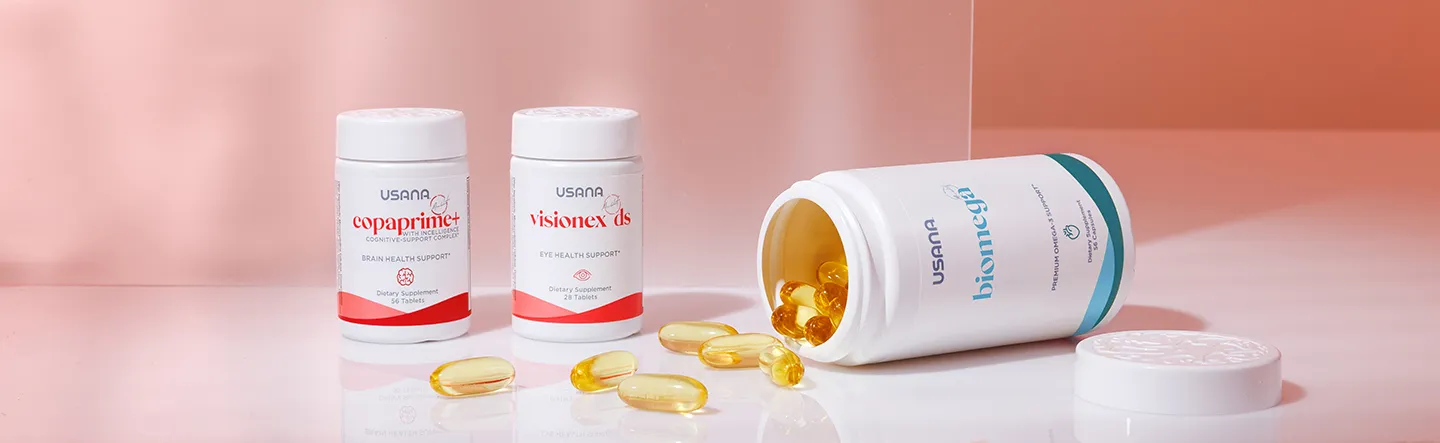
On oxidation, USANA uses molecular distillation to purify the fish oil and remove contaminants, including heavy metals, PCBs, and dioxins. The oil is then encapsulated with a lemon flavour that masks any fish taste, but more practically serves as an indicator of freshness. If the capsule smells strongly fishy rather than lemon-fresh, that’s a signal the oil has begun to oxidise.
Fresh, high-quality fish oil in a well-sealed capsule should have minimal fishy odour. Omega-3 BiOmega consistently passes this test, and the quantities are guaranteed – what’s on the label is guaranteed to be in the bottle.
With each dose, each BiOmega serving delivers a combined EPA and DHA dose that sits within the range used in cardiovascular and anti-inflammatory research. You’re not taking a token amount and hoping for the best; you’re taking the optimal amount, daily.
On form, USANA BiOmega provides the omega-3 in a concentrated, bioavailable form designed for efficient absorption. The product is manufactured in USANA’s FDA-registered facility to pharmaceutical GMP standards, with the same quality controls I covered in Chapter 2 applying to every batch.
Who Needs Omega-3 Supplementation
The honest answer is that most people in Western countries. The modern Western diet is heavily skewed toward omega-6 fatty acids found in vegetable oils, processed foods, and grain-fed meat, and severely lacking in the omega-3s found in cold-water fatty fish. The ideal omega-6-to-omega-3 ratio in the diet is thought to be between 4:1 and 1:1. The average Western diet is around 15:1 or higher.7
This imbalance matters because omega-6 and omega-3 fatty acids compete for the same enzymes in your body. When omega-6 dominates, it drives the production of pro-inflammatory compounds. When omega-3 is present in adequate amounts, it counterbalances this, supporting a healthier inflammatory response. Chronic low-grade inflammation is now understood to be a driver of cardiovascular disease, type 2 diabetes, certain cancers, and neurodegenerative conditions. Correcting the omega-6-to-omega-3 ratio through supplementation is one of the more evidence-based dietary interventions available.
People with a particular need for omega-3 supplementation include those who rarely or never eat fatty fish like salmon, mackerel, sardines, or anchovies. People over 40, where cognitive and cardiovascular protection become more pressing priorities. People managing elevated triglycerides, for which omega-3 at therapeutic doses has strong research support. Pregnant and breastfeeding women, where DHA is critical for foetal brain and eye development. And anyone managing chronic inflammation, joint pain, or mood instability, where the anti-inflammatory effects of EPA are well-documented.
How to Take USANA BiOmega Correctly
Take Omega-3 BiOmega with a meal that contains some dietary fat. Fat-soluble nutrients, including omega-3 fatty acids, are absorbed significantly better when taken alongside food containing fat. Taking your omega-3 capsule with a fat-free meal or on an empty stomach reduces its absorption and undermines the point of taking it.
Store the product in a cool, dark place and keep the bottle sealed when not in use. Heat, light, and oxygen are the enemies of fish oil quality, and how you store the product after purchase affects how quickly it degrades.
Give it at least 8 to 10 weeks before evaluating effects. Omega-3 works by gradually shifting the fatty acid composition of your cell membranes, which is a slow process. People expecting immediate noticeable effects are usually disappointed, but the long-term cardiovascular and inflammatory benefits accumulate over months and years of consistent use.
The Lemon Trick – A Quick Quality Test for Any Fish Oil
This is something I’ve shared with clients for years. Open your fish oil capsule or bottle and smell it. Fresh, high-quality fish oil should smell mild and slightly oceanic, not strongly fishy or rancid. If it smells like old fish, it’s already oxidised, and you’re better off discarding it.
With USANA BiOmega, the lemon flavouring means you should smell lemon first and very mild fish oil underneath. If the fishy smell is dominant, that’s your indicator. In practice, I’ve never encountered this with BiOmega because of how USANA handles the processing and packaging, but it’s a useful test to apply to any omega-3 product you’re evaluating.
Shop USANA BiOmega Omega-3
Available for delivery to New Zealand, Australia, and the USA. Sign up as a Preferred Customer at checkout and save up to 20% off retail pricing.
References
- Burdge GC, Calder PC. Conversion of alpha-linolenic acid to longer-chain polyunsaturated fatty acids in human adults. Reprod Nutr Dev. 2005;45(5):581-597. PubMed
- Mozaffarian D, Wu JH. Omega-3 fatty acids and cardiovascular disease. J Am Coll Cardiol. 2011;58(20):2047-2067. PubMed
- Innis SM. Dietary omega-3 fatty acids and the developing brain. Brain Res. 2008;1237:35-43. PubMed
- Albert BB, et al. Fish oil supplements in New Zealand are highly oxidised and do not meet label content of n-3 PUFA. Sci Rep. 2015;5:7928. PubMed
- Jackowski SA, et al. Oxidation levels of North American over-the-counter n-3 supplements. J Nutr Sci. 2015. PubMed
- Dyerberg J, et al. Bioavailability of marine n-3 fatty acid formulations. Prostaglandins Leukot Essent Fatty Acids. 2010;83(3):137-141. PubMed
- Simopoulos AP. The importance of the ratio of omega-6/omega-3 essential fatty acids. Biomed Pharmacother. 2002;56(8):365-379. PubMed