
Blog
The Benefits of USANA’s Clear Protein and Creatine Mix
Aug
USANA Clear Protein and Creatine Mix: A Nutritionist’s Honest Breakdown
By Dale Folland, Nutritionist, 25-year USANA Brand Ambassador
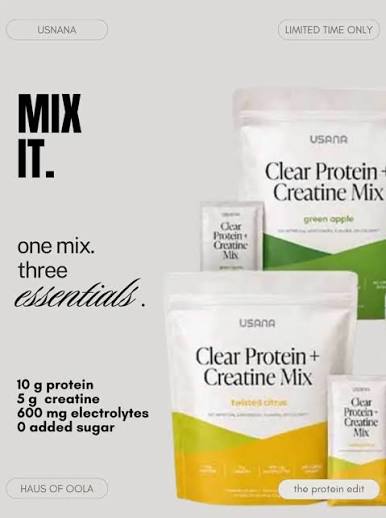
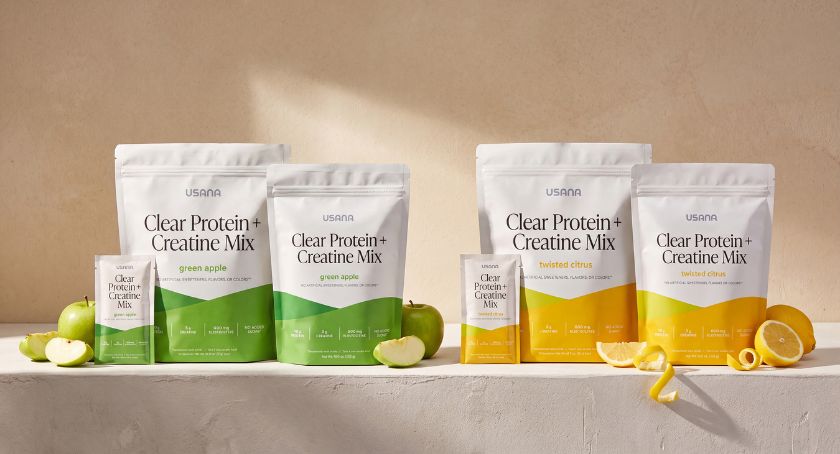
USANA launched its Clear Protein and Creatine Mix on August 17, 2026, in two flavors, Twisted Citrus and Green Apple. It’s a clear drink, not a shake, and it packs 10g of whey protein isolate, 5g of creatine monohydrate, and 600+mg of electrolytes into 50 calories with zero added sugar.
I’ve had people asking me about it since the announcement, mostly with the same question: is this actually useful, or is it just protein powder wearing a cleaner outfit?
I want to answer that properly, because I think the open answer sits somewhere between ‘genuinely well-formulated’ and ‘don’t expect it to do a shake’s job ‘, so let’s get into the numbers.
What’s In a Single Scoop
Here’s what a single scoop of USANA Clear Protein and Creatine Mix actually contains, per serving: 50 calories, 10g clear whey protein isolate, 5g micronized creatine monohydrate, 600+mg electrolytes, no added sugar, no artificial flavors or colors.
It comes in 20-serving bags and 14-count single-serve packets, mixed with 8-10 ounces of water. USANA’s Chief Scientific Officer, Dr. Kathryn Armstrong, described the goal as building the formula “around research-backed ingredients to provide meaningful contribution of each.” On the numbers, that’s a fair description.
Nothing here is a token dose, and nothing is padded past what the evidence supports either. Why it’s clear, and why that doesn’t matter as much as people think.
The clarity comes from hydrolyzed whey protein isolate, which strips out the fats and larger protein fragments that make a standard shake look milky and taste heavy. It’s a genuine manufacturing achievement. Getting protein to stay in solution in a citrus-flavored drink without curdling or turning gluey is something that the USANA Scientists are always good at.
But clarity is a texture and marketing win, not so much a nutritional one. It’s important to know that the protein itself doesn’t digest differently because it’s clear, and if you’ve been avoiding protein drinks because you don’t like the mouthfeel of a shake, this now solves that problem. If you were hoping clear protein does something extra for muscle building that opaque whey doesn’t, it doesn’t.
What Level Of Creatine Is in the Clear Protein and Creatine Mix?
Five grams of creatine is the right number to have per serve, it’s not a marketing number The International Society of Sports Nutrition’s 2017 position stand on creatine (Kreider et al., Journal of the International Society of Sports Nutrition) lays out the dosing pretty clearly: a loading phase of 20-25g per day for 5 to 7 days saturates muscle creatine stores fastest, but 3-5g per day gets you to the same place over about a month, and larger athletes can need up to 10g/day for maintenance.
Five grams sits right in the middle of that maintenance range. It won’t load you as fast as the classic loading protocol, but if you’re taking it daily, that difference disappears within a few weeks.
On safety, the same position stand is unambiguous: doses up to 30g per day for five years show no credible evidence of harm in healthy people. I’ve recommended creatine monohydrate to clients for most of my career, and it remains one of the few supplements where the research is this settled. There’s no cycling requirement. You don’t need rest weeks. Taking it daily is the point, and you can actually feel the results with your strength training.
Doesn’t Creatine Hold Water and Damage Kidneys?
The bloating and kidney myths need killing, again
Two things come up in almost every conversation I have about creatine: ‘won’t it make me hold water’ and ‘isn’t it hard on your kidneys.’ Antonio et al.’s 2021 review in the Journal of the International Society of Sports Nutrition, “Common questions and misconceptions about creatine supplementation,” addresses both directly. The water retention that shows up in the first few days is intracellular, inside the muscle cell, and it’s actually part of the signal that drives protein synthesis.
Longer-term studies (5 to 10 weeks) don’t show meaningful increases in total body water relative to muscle mass. One study on football players training in heat found creatine users had less cramping (p = 0.021) and fewer heat illnesses and dehydration events (p = 0.043) than the placebo group, not more.
On kidneys, the review calls this ‘perhaps second only to the myth that protein supplementation… causes kidney damage.’ After close to three decades of use and thousands of documented cases, there’s no evidence of kidney damage in healthy individuals at the 3 to 5g range. If you have existing kidney disease, that’s a conversation with your doctor, not a supplement label. For everyone else, this fear has outlived its evidence by a couple of decades now.
What Is The Correct Serving Of Protein Per Serve?
Ten grams of protein is a useful daily top-up between meals. But if you’re after a solid amount of protein, you may want to consider USANA Nutrimeal Protein
This is where I’ll be direct instead of diplomatic: 10g of protein is not enough to drive a meaningful muscle-building response on its own, and USANA isn’t claiming otherwise, but plenty of buyers will assume it replaces a proper protein serving. It doesn’t; I would be adding to your protein requirements per day if you are a heavy exerciser.
Schoenfeld and Aragon’s 2018 paper in the Journal of the International Society of Sports Nutrition, “How much protein can the body use in a single meal for muscle-building?”, found that maximizing the anabolic response takes something closer to 0.4g of protein per kilogram of bodyweight per meal, which for most adults lands between 25 and 45g.
Studies comparing 10g, 20g, and 40g whey doses (Areta et al.; Macnaughton et al.) consistently found the larger doses drove a bigger muscle protein synthesis response. Ten grams isn’t nothing, amino acids from it still get used, but it’s a supporting dose, not a primary one to consider having once per day and expecting sufficient muscle growth and recovery.
Where this product actually earns its place is as a way to get creatine and electrolytes in without needing a separate mixing routine, with a protein bump along for the ride. Pair it with a meal that already has real protein in it, and you’re not losing anything. Expect it to replace your post-workout shake, and you’ll come up short on your potential protein requirements.
Why Is There 600mg Electrolytes In A Protein Drink?
Electrolytes belong in this formula, and 600mg is a reasonable volume and here’s why.
Creatine pulls water into muscle cells, and that shift works better when sodium and potassium are along for the ride. That’s not a coincidence in how this product is put together – it’s a well-thought-out addition from the team at USANA.
Sports drinks generally run 35 to 200 mg of sodium per 8 ounces, and total sweat losses during hard training in heat can run well past what a single serving of anything replaces. So 600mg of combined electrolytes is a solid daily floor, especially for someone training indoors or in mild conditions, but it isn’t going to fully cover you through a two-hour session in real heat.
On those days, you still need a proper sports drink or added electrolytes on top of this. Also, Zero added sugar is a real feature, not just a label line to draw in a sale.
The World Health Organization recommends keeping free sugars under 10% of total energy intake, with additional benefit below 5%. A daily USANA protein creatine mix is exactly the kind of product that quietly adds up if it’s carrying 15-20g of sugar per serving, which plenty in this category do. Zero added sugar here means you can use it daily without it eating into that budget. That’s a genuine formulation choice which is why I trust these products and the brand for the last 25 years.
USANA Health Sciences Facility
USANA Clear Protein and Creatine Mix is produced in an FDA-registered, GMP-certified facility with batch testing for quality, purity, and potency. An FDA facility registration is a requirement under federal law for any facility that manufactures or holds dietary supplements. It’s not the same as FDA approval. The FDA does not approve supplement formulas before they go to market, and registration on its own doesn’t mean a specific product has been reviewed by anyone at the agency.
What carries more weight, in my view, is what USANA does beyond that baseline: their Salt Lake City facility has been NSF GMP-listed since 2006, and USP-certified since 2018, and the company has said publicly it applies pharmaceutical-grade manufacturing standards (21 CFR Part 211) rather than the lower bar that applies to supplements generally (21 CFR Part 111).
That’s a real, checkable difference in my opinion. One thing I didn’t see in the USANA launch materials: no mention of third-party sport-specific certification, like NSF Certified for Sport, for this particular product. If you’re a tested athlete, that’s worth confirming directly with USANA before you rely on it.
When To Use The Protein And Creatine Mix.
If you’re already eating enough protein and want a simple way to get creatine and electrolytes in without another shaker bottle, this fits perfectly well, especially first thing in the morning or around training when a heavy shake isn’t appealing. If your protein intake is the thing you’re actually short on, don’t let the ‘protein’ in the name fool you into skipping your real protein source.
Is creatine safe to take every day? Yes, based on decades of research at the 3-5g range, including in this product’s 5g dose.
Do I still need a separate protein shake? Probably, if muscle building or recovery from serious training is the goal. Ten grams supplements a meal; it doesn’t replace one.
Does it matter when I drink it? The Creatine and Protein benefit comes from consistent daily saturation, not precise timing. Have it whenever it fits your day, but generally in between meals would be a good start.
I’d rather tell you exactly where a product’s edges are than pretend it does everything. This one does two things well: creatine dosing and sugar-free formulation, does electrolytes adequately, and does protein modestly. Buy it for the first two, not the third.
This article reflects publicly available research and USANA’s own product information as of August 2026. It’s informational, not medical advice; these statements haven’t been evaluated by the FDA, and this product isn’t intended to diagnose, treat, cure, or prevent any disease. Talk to your doctor before starting any new supplement, particularly if you have kidney disease or another existing condition.
Sources
Kreider, R.B. et al. (2017). International Society of Sports Nutrition position stand: safety and efficacy of creatine supplementation in exercise, sport, and medicine. Journal of the International Society of Sports Nutrition. springer link
Antonio, J. et al. (2021). Common questions and misconceptions about creatine supplementation: what does the scientific evidence really show? Journal of the International Society of Sports Nutrition. springer link
Schoenfeld, B.J. & Aragon, A.A. (2018). How much protein can the body use in a single meal for muscle-building? Journal of the International Society of Sports Nutrition. springer link
World Health Organization. Guideline: Sugars intake for adults and children. NCBI Bookshelf
U.S. FDA. Questions and Answers on Dietary Supplements. fda.gov
USANA Health Sciences. USANA Introduces 3-in-1 Protein, Creatine, and Electrolyte Drink Mix (press release, August 2026). PR Newswire
NSF International. GMP Certification Listing for USANA Health Sciences. info.nsf.org